Fact-check complete · July 29, 2026

China’s giant fusion magnet claim is largely true

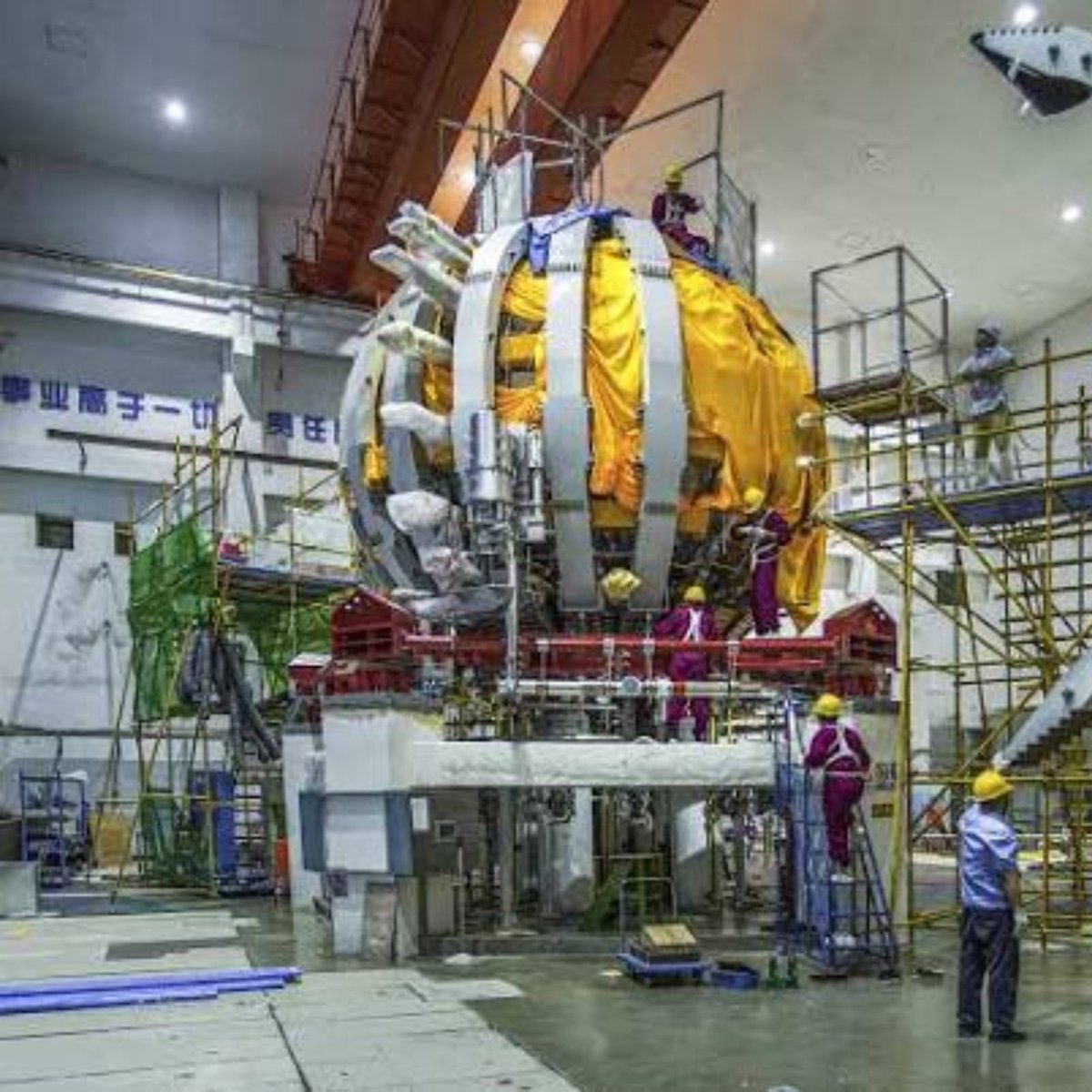
We verified @openlabxorg’s post about a 582-tonne superconducting toroidal-field magnet for China’s “artificial sun” programme against official Chinese Academy of Sciences coverage, China Daily, CGTN, and international fusion reporting.

Original post: Jul 29, 2026 Event date: Jun 27–28, 2026 Lab: ASIPP / CAS · Hefei
Mass
582 t
Metric tonnes · D-shaped TF coil
Envelope
21×12×3.3 m
Length · width · height
vs ITER TF
1.3× vol
~3× stored magnetic energy
Programme
CRAFT
ASIPP · Hefei · CAS
Source post

What the tweet said

Posted by OpenlabX (@openlabxorg) on July 29, 2026 — summarizing a late-June milestone from China’s fusion programme.

OX
OpenlabX
@openlabxorg · Jul 29, 2026

🇨🇳 China built world's largest superconducting magnet for its artificial sun :

  • The 582 tonne toroidal-field magnet measures roughly 21 × 12 × 3.3 metres. About 1.3× larger than ITER’s equivalent magnets & can store roughly 3× more magnetic energy.
  • Its job is to create an extremely powerful magnetic cage around plasma heated beyond 100 million°C, preventing it from touching & destroying the reactor walls.
  • The magnet was developed for China’s next-generation fusion programme, building on EAST’s record of sustaining high-performance plasma for 1,066 seconds in 2025.
Post ID 2082341174573236595 Open on X →

Who built it?

Institute of Plasma Physics (ASIPP), Hefei Institutes of Physical Science, Chinese Academy of Sciences — the same team behind EAST, China’s long-running “artificial sun” tokamak.

ASIPP CAS Hefei

Which project?

Part of CRAFT (Comprehensive Research Facility for Fusion Technology) — a national major science infrastructure with ~20 specialised test stands for magnets, heating, blankets, and tritium systems. Not a bolt-on to EAST alone.

When was it accepted?

Expert panel acceptance and full-parameter testing were announced June 27–28, 2026 (China Daily, CGTN, CAS English). The viral tweet is a later repost of that news.

Claim audit

Every claim, checked

Cross-checked against CAS English, China Daily, CGTN/WIC, India Today science coverage, World Nuclear News, Physics World, and ITER public specs.

Claim Status What we found
World’s largest superconducting magnet for fusion (“artificial sun”) ✓ Verified ASIPP states this is currently the largest fusion-reactor superconducting magnet of its kind. Accepted June 27, 2026 as CRAFT’s largest superconducting component. “Largest” is scoped to a single TF unit class — not ITER’s whole multi-magnet assembly (~10,000 t combined magnet systems).
582 tonnes; ~21 × 12 × 3.3 m ✓ Verified CGTN/WIC: 21 m long, 12 m wide, 3.3 m high, 582 tonnes. China Daily / CAS: 582 metric tons. Matches the tweet exactly.
~1.3× larger than ITER equivalent magnets ✓ Verified CAS / China Daily: volume is 1.3× that of ITER’s toroidal-field magnet. ITER TF coils are publicly listed as ~17 m high × 9 m wide and ~360 t each — consistent with a larger Chinese unit.
~3× more magnetic energy than ITER TF ✓ Verified CAS developers: energy storage capacity is three times greater than ITER’s TF magnet. Secondary encyclopedic summaries cite ~120 GJ stored energy and ~98 kA operating current for this CRAFT magnet.
Creates a magnetic cage so ~100M°C plasma doesn’t hit the walls ✓ Verified Standard, correct description of a tokamak toroidal-field magnet’s job. CAS: TF field “firmly constrains the plasma and reduces impact… on the vacuum chamber walls.”
Next-gen programme; builds on EAST’s 1,066 s record (2025) ✓ Verified EAST sustained steady-state high-confinement plasma for 1,066 seconds on Jan 20, 2025 (CAS / Xinhua). Magnet is for CRAFT / next-gen path (BEST → CFETR), not a retrofit of the existing EAST machine.
Implied: ready to power a commercial artificial sun tomorrow ~ Nuance The tweet doesn’t overclaim electricity production. Still: a magnet milestone ≠ net-energy fusion plant. Assembly, multi-magnet systems, tritium fuel cycle, and Q>1 commercial operation remain multi-year challenges.

World’s largest fusion SC magnet

✓ Verified

ASIPP / CAS: largest of its kind for fusion reactors. Single TF unit — not entire ITER magnet suite.

582 t · 21 × 12 × 3.3 m

✓ Verified

Exact match to CGTN, China Daily, and CAS English reporting.

1.3× volume · 3× energy vs ITER TF

✓ Verified

Stated by developers; consistent with ITER TF public dimensions (~17×9 m, ~360 t).

Magnetic cage for 100M°C plasma

✓ Verified

Correct physics description of toroidal-field confinement.

EAST 1,066 seconds (2025)

✓ Verified

CAS/Xinhua Jan 2025. Note: France’s WEST later reported 1,336 s plasma duration (Feb 2025) — different metric context.

Ready for grid power now?

~ Nuance

Magnet accepted ≠ commercial fusion plant. Roadmap still points to late-2020s demo steps.

Engineering comparison

China CRAFT TF vs ITER TF

Side-by-side numbers. ITER remains the world’s largest overall experimental fusion machine under construction; China’s unit is the largest single TF magnet reported for a fusion reactor class.

China CRAFT TF magnet

🇨🇳 ASIPP · 2026
  • TypeToroidal-field SC magnet
  • Mass582 tonnes
  • Size21 × 12 × 3.3 m
  • vs ITER volume1.3×
  • Stored energy~3× ITER TF
  • Op. current (reported)~98 kA
  • Design life~60 years
  • ProgrammeCRAFT / next-gen fusion
  • Localization100% domestic (claimed)

ITER TF coil (each)

🌍 EU / Japan · ITER
  • TypeToroidal-field SC coil
  • Mass~360 tonnes each
  • Size~17 m high × 9 m wide
  • Number of TF coils18 coils
  • Peak field (CS ref.)Up to ~13 T (CS)
  • All magnets (system)~10,000 t total
  • System energy~51 GJ combined
  • SiteCadarache, France
  • GoalQ=10 · 500 MW fusion power
SCALE Relative comparison of single-unit size & energy (not whole reactor readiness)
Mass — China CRAFT TF 582 t
582 t
Mass — ITER TF (each) ~360 t
~360 t
Relative magnetic energy (ASIPP claim) China = 3× ITER TF
China · 3×
Relative magnetic energy — ITER TF baseline
ITER TF · 1×

Also accepted the same day: a high-temperature superconducting central solenoid coil (CGTN: 60 kA, 6.03 MJ) — the “spark plug” that drives plasma current.

Physics in plain language

Why this magnet matters

Fusion needs star-core heat without melting the machine. Superconducting magnets are the invisible cage that makes that possible.

1

Heat the fuel past 100 million °C

Deuterium–tritium plasma must be hotter than the Sun’s core so nuclei can overcome electrostatic repulsion and fuse — releasing energy.

2

No material wall can hold it

At those temperatures, contact with solid walls destroys both the plasma and the reactor. You need a non-material container.

3

TF magnets make the cage

Toroidal-field coils wrap the doughnut-shaped tokamak chamber, bending charged particles into closed orbits — a magnetic bottle.

4

Superconducting = extreme current, tiny loss

Cooled near −269 °C, the winding carries enormous current with almost no resistance — essential for sustained, high-field operation.

5

From component to power plant

One accepted magnet is a manufacturing breakthrough. A working plant still needs a full set of magnets, vacuum vessel, divertor, heating systems, tritium breeding, and proof of net electricity. China’s roadmap sequences BEST (burning plasma experiment), early power generation targets around 2030, and CFETR as a demonstration reactor — ambitious, not yet operational grid power.

Programme context

How we got here — and what’s next

The magnet sits inside a multi-decade Chinese fusion ladder: EAST physics → CRAFT engineering → BEST → CFETR.

2006 →

EAST begins operations

Experimental Advanced Superconducting Tokamak in Hefei becomes a flagship long-pulse plasma platform and open international test bed.

Jan 2025

EAST holds plasma 1,066 seconds

World-record steady-state high-confinement (H-mode) operation at the time — the milestone referenced in the tweet.

Oct 2025

TF coil box delivered (21 × 12 m)

Shanghai Electric delivers the 400-tonne structural coil case for CRAFT’s toroidal-field magnet — the giant steel “frame” that protects windings.

Jun 27–28, 2026

582 t TF magnet accepted + CS tested

Expert review acceptance of the world’s largest fusion TF superconducting magnet; high-temperature superconducting central solenoid completes full-parameter tests.

Target ~2027

BEST tokamak first plasma window

Burning Plasma Experimental Superconducting Tokamak aims for deuterium plasma operation; D–T plans under review. Civil works started 2023 at the CRAFT campus.

~2030+

Power generation ambitions · CFETR

Chinese coverage cites first fusion power generation targets around 2030 and CFETR as a future engineering demonstration reactor. These remain programme goals, not guaranteed dates.

Extra engineering notes

6 yr

Development cycle for the TF magnet (design → materials → manufacturing → test).

47

Patents reported from the programme (CGTN / India Today; some sources also cite 14–25 standards).

−269°C

Cryogenic operating regime for superconductivity, while surviving radiation and huge mechanical loads for decades.

100 kA+

India Today notes joint resistance reduced so currents exceeding 100,000 A can flow with near-zero loss — critical for commercial concepts.

16×

Some technical summaries state a future device would use 16 such TF magnets for ~6.5 T at the plasma center (peak field ~14.5 T on the magnet).

Bottom line: The tweet’s physics and numbers hold up. Treat “artificial sun ready” headlines as engineering progress — not a switched-on power plant.

Honest framing

What the tweet gets right — and what to watch

Strong science communication still benefits from precise boundaries.

“World’s largest” is unit-scoped

Accurate for a single fusion TF superconducting magnet. ITER’s overall pulsed magnet system and multi-coil suite are still a different scale of integrated facility.

EAST record has a footnote

1,066 s H-mode (Jan 2025) is real. France’s WEST later reported a longer plasma duration (1,336 s). Duration records evolve; EAST remains a major long-pulse platform.

Milestone ≠ megawatts on the grid

Acceptance of a magnet is necessary but not sufficient for commercial fusion. Integration, fuel cycle, and net electricity remain the hard remaining steps.

Primary & secondary sources

Where the verification came from

Prefer official institute and wire reporting over pure social reposts.

Verdict: the tweet holds up

Core engineering claims match official CAS and state-media reporting from late June 2026. Read it as a verified manufacturing milestone on China’s fusion path — not as proof of commercial fusion electricity today.